Schools, universities and learners: it’s time to get your facts straight
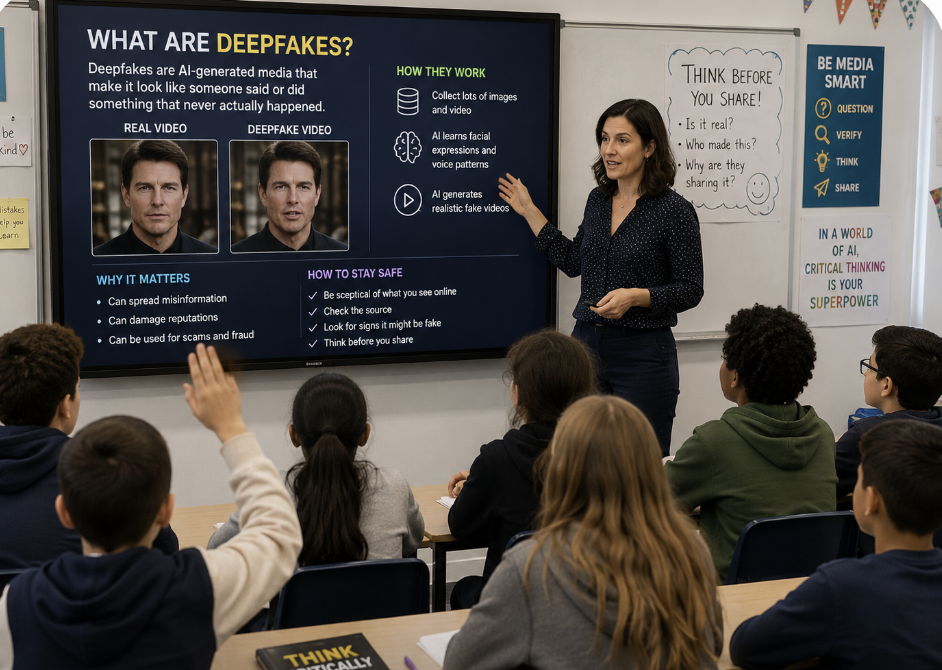
Earlier this year, a student at the University of Edinburgh submitted a deepfake video of themselves delivering a final presentation—only for AI detection software to flag inconsistencies. The incident, though minor, revealed a stark truth: deepfakes are infiltrating classrooms, threatening academic integrity and reshaping how institutions assess learning. Here, we detail 10 critical insights for educators and learners alike.
- AI-generated content blurs the line between original work and plagiarism
Tools like GPT-4 and MidJourney enable students to produce essays, images or videos that mimic their style. A 2023 study by Jisc, the UK’s education tech body, found 18% of university submissions contained AI-generated text without disclosure.
- Deepfake submissions are already undermining assessments
Beyond text, video deepfakes allow students to “attend” online exams via AI clones. Platforms like Proctorio report a 250% surge in deepfake-based cheating since 2022, with fraudsters using apps like DeepFaceLab to swap faces in live feeds.
- Lectures and seminars are being forged to spread misinformation
Deepfake videos of professors delivering false content—e.g., endorsing unproven theories or misstating facts—have circulated on academic forums. In 2023, a fake lecture by a Harvard economist on “currency collapse” went viral before being flagged, causing unnecessary market jitters.
- Identity verification in online learning is under threat
Synthetic voices (via AI tools) can bypass voice-based attendance checks, while deepfake faces may fool facial recognition systems. A survey by the British Council found 34% of UK schools using remote learning had experienced identity fraud attempts.
- Curricula are vulnerable to deepfake misinformation
History, science and current affairs lessons rely on visual and audio resources. Deepfake videos—such as a fabricated “interview” with a deceased figure or falsified lab experiments—risk normalizing falsehoods. The UNESCO Institute for Statistics warns of a “deepfake literacy gap” among younger learners.
- Teaching staff need deepfake detection training
Educators must learn to spot AI-generated red flags: text with unnatural coherence, images lacking shadow consistency, or videos with mismatched lip movements. The National Union of Teachers (NUT) now includes deepfake literacy in its professional development guidelines.
- Plagiarism policies must evolve to address AI deception
Traditional policies focus on human plagiarism; deepfakes require updating definitions to include AI-generated content. The University of Oxford’s 2023 academic integrity policy now mandates students to declare AI tools used in submissions.
- Collaboration tools are being exploited for fraudulent content
Platforms like Google Classroom or Microsoft Teams may host deepfake group projects, where AI clones “participate” in discussions. Schools in Scotland reported a 40% rise in such cases after deploying collaborative video tools.
- Ethical dilemmas over AI’s role in education are intensifying
While AI aids learning (e.g., language practice), its misuse raises questions: should deepfakes be treated as cheating, or as a new form of creativity? The Higher Education Policy Institute (HEPI) is urging institutions to clarify ethical boundaries.
- Proactive tech adoption is key to preserving trust
Integrating AI detectors into learning management systems (LMS) can flag suspicious content pre-submission. VerifyLabs.AI’s education-focused tools, for example, scan essays for AI patterns and videos for synthetic artifacts, reducing review time by 60%.
Deepfakes challenge education’s core purpose: to foster critical thinking and truth-seeking. By updating policies, training staff and adopting robust verification tools, institutions can protect academic rigor. VerifyLabs.AI’s Deepfake Detector helps people stay on track—so learning can stay authentic.