
August 11th 2026
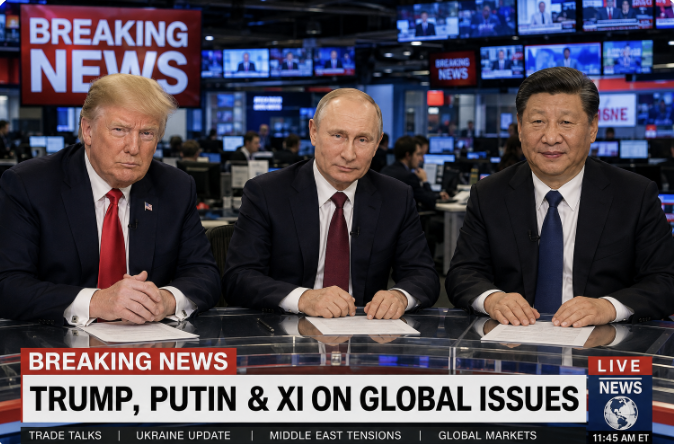
There’s a particular feeling that visits a newsroom when a clip lands from somewhere nobody can quite vouch for. It’s twenty minutes to air. The pictures are extraordinary. Someone says, “It looks right to me.” Someone else says, “Where did it come from?” And a decision gets made, usually well, sometimes on instinct, always faster than anyone would like.
For most of the history of broadcasting, instinct was enough, because the pictures did the arguing for us. Film authenticated itself. You ran the tape and the tape was the evidence. That single assumption—that an image or audio of a thing was proof of the thing—held up the whole edifice: the correspondent to camera, the shaky phone footage from the front line, the recording that ended a career.
That assumption has quietly expired. Not in some distant future, and not only in elections and war zones. It has expired in the ordinary Tuesday-afternoon business of deciding what to put on air.
This is the finding I’d gently press on any editor who believes their people can spot a fake. In 2024, researchers pooled 56 studies covering more than 86,000 participants and found that human accuracy at identifying deepfakes came out at 55.54% — with confidence intervals crossing 50%, meaning performance was statistically indistinguishable from chance. Interestingly, people were rather better at recognising genuine material (68%) than fabricated material. We are, in other words, generously inclined to believe our eyes. (Diel et al., Computers in Human Behavior Reports, 2024)
I don’t offer that as an insult to anyone’s craft. It’s simply a fact about human perception, and it means that “our team is very experienced” is not a verification policy. It’s a hope, which won’t survive contact with a well-made synthetic video at ten to the hour.
Meanwhile the volume keeps climbing. One detection firm, IdentifAI, logged 3,165 deepfake incidents in March 2026 alone, against just four in January 2020 — a scale of increase that no fact-checking desk can absorb by working harder. (Digiday, April 2026)
Here is where it gets hopeful, oddly.
The Reuters Institute’s 2026 Digital News Report, drawn from nearly 100,000 people across 48 markets, makes for a bruising read at first glance. Trust in news has fallen to 37% — the lowest since measurement began in 2015 — declining in 29 of the 48 markets surveyed. Concern about fake news online has risen to 62% globally. In the UK it reaches 77%, with 73% of Britons saying they distrust news on social media. (Reuters Institute, June 2026)
Read those numbers again, though, and listen for what people are really saying. They are not telling us they’ve stopped caring about the truth. They are telling us they are frightened of being fooled, and that they don’t currently know who can help. Notably, the same report found trust in individual, well-used news brands has held up rather better than trust in “the news” as a category — audiences are still willing to distinguish between us and the noise.
That is not a death sentence. That is a demand signal, and it is the loudest one our industry has had in years.
Attention was the currency of the last two decades, and chasing it very nearly bankrupted us both commercially and, at times, morally. The currency of the next two decades is quieter and worth far more: the ability to say, with evidence, this is real, and here’s how we know. Understanding cannot survive without provenance. An audience that can’t tell the authentic from the synthetic doesn’t become better informed by consuming more of it. It becomes more confidently wrong, or it walks away altogether—and the 2026 data shows both happening at once.
We tend to picture the danger as the fake that slips through and gets published. That’s real, and it’s frightening.
But the deeper wound is what the legal scholars Bobby Chesney and Danielle Citron named the “liar’s dividend” in their 2018 paper for the California Law Review: once everyone knows anything can be faked, anything can be denied. Authentic footage of genuine wrongdoing gets waved away as AI. The guilty acquire a universal alibi. And the journalist who took a genuine risk to obtain that recording is left holding evidence that no longer functions as evidence. (Chesney & Citron, 2019)
Their unsettling observation was that the dividend grows as public awareness grows. The more we all learn about deepfakes, the more persuasive the denial becomes.
Detection guards both flanks. It stops the fabrication going out — and, just as importantly, it lets us stand behind real material under pressure with forensic analysis rather than wounded institutional insistence. In a world where denial costs nothing, being able to prove authenticity isn’t a defensive expense. It’s editorial firepower, and it protects our own people.
Excellence in journalism has always been asserted rather than measured. Awards, mastheads, decades of hard-won reputation. None of that travels well on a platform feed, where a national broadcaster and an anonymous account appear at precisely the same size. Where, in 2026, social media and video networks overtook news organisations’ own websites and apps as the way people reach news online.
Verification changes that, because verification can be shown. Detection results can be logged. Standards can be published. Chain of custody can be recorded from capture to broadcast and displayed to the audience on air, on the page, in the app, in the same spirit as a corrections column, which is one of the most trust-building things our industry ever invented. An outlet that shows its working turns credibility from a claim into a benchmark, and quietly invites everyone else to be measured against it.
One caveat, and I’d argue it belongs in any honest conversation about this: no detector is infallible, and anyone selling you certainty is selling the very thing that got us into trouble. Detection is an instrument, not an oracle. It belongs inside editorial process, in the hands of trained journalists, treated as strong evidence rather than a verdict. The outlets that get this right will be the ones candid about their confidence levels, as calibrated honesty is precisely what we’re asking our audiences to buy.
It’s tempting to file all this under media economics. I don’t think that’s quite right.
Societies make decisions about wars, elections, medicines, currencies, one another—on a shared factual floor. News organisations are among the last institutions with both the reach and the mandate to maintain it. The World Economic Forum’s Global Risks Report 2026 ranked misinformation and disinformation the second most severe short-term global risk facing the world, the third consecutive year these threats have sat near the top of the list. (WEF, January 2026)
If synthetic media dissolves that floor, the losses won’t be counted in subscriptions. They’ll be counted in the ordinary civic ability of people to agree on what happened yesterday.
That is the service. That is what a deepfake detector in a newsroom is actually for.
Every outlet will have one eventually, in the way every outlet eventually had a website. The only question worth asking is whether yours arrives early as a strategic asset, visible to your audience, central to how you describe yourself. Or whether it arrives as an emergency purchase, made the morning after you broadcast something that wasn’t true.
I’d rather we chose the first. We have done harder things than this, and we have rarely had a clearer invitation from the people we serve.
