Why authenticity is essential for emotional security
The conversation around deepfake technology often focuses on fraud and politics. Yet, the deepest impact is felt on a human level: it attacks our sense of self and shatters digital trust. We are facing a crisis of reality. Seeing is no longer believing.
Disconnection from the authentic self is today recognised as a major contributor to mental and physical health issues in adulthood. It creates an inner tension and a sense of isolation, even when surrounded by others.
At VerifyLabs.AI, we understand that what starts as a digital problem quickly develops into a spectrum of real-life issues which can present huge challenges to the individuals involved. The need is to both create safety in the online environment, while also actively defending the integrity of human relationships there.
The trauma of being manipulated
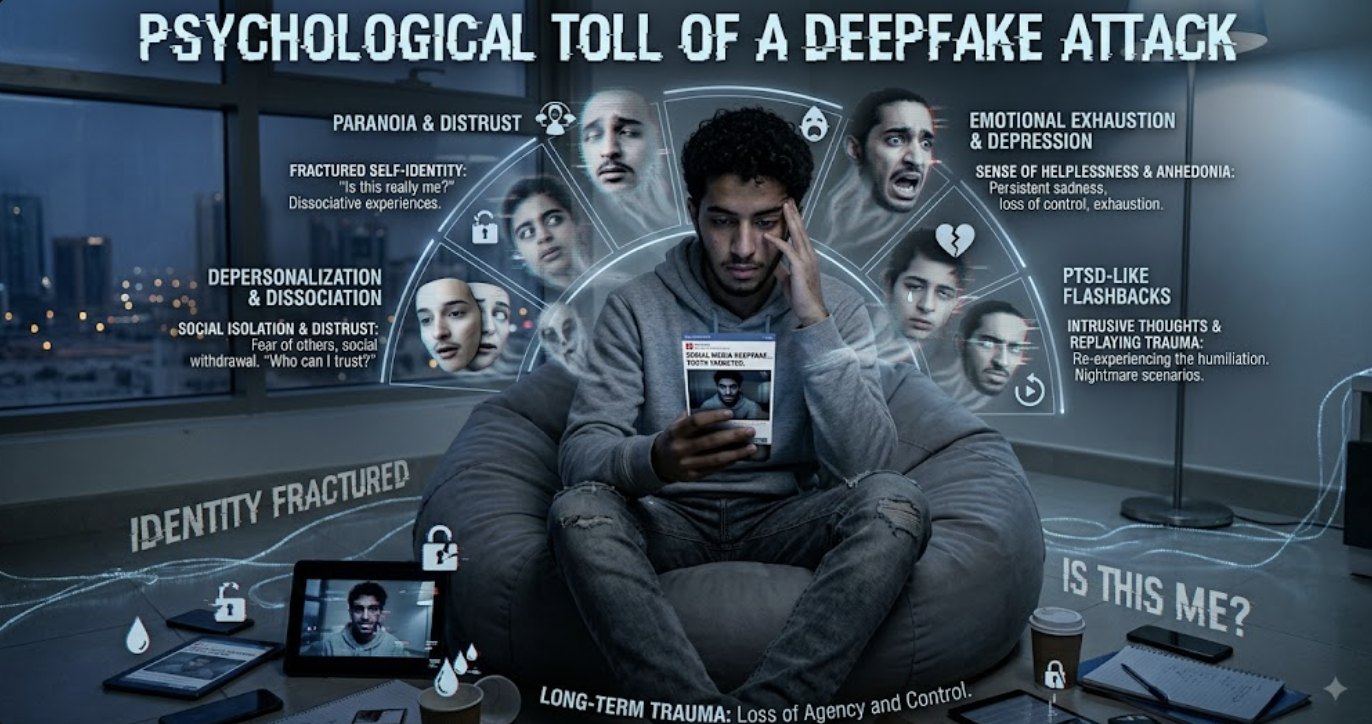
For victims, exposure to synthetic media is profoundly violating. Imagine seeing yourself—or hearing your own voice—saying or doing something terrible that you never did. This isn’t just defamation; it is many-layered trauma that evolves over a period of time.
- Loss of control: victims feel powerless. Their own likeness has been weaponised against them, often without their knowledge or consent. This invasion of personal autonomy causes many psychological repercussions ranging from anxiety to suicide.
- Reputational damage: the humiliation and shame are immediate and ongoing. Even if the content is proven fake, the image or audio remains online. An often-permanent digital stain leads to withdrawal and fear for future prospects.
- Ongoing psychological distress: victims of non-consensual deepfakes can exhibit trauma similar to victims of cyber stalking, including severe emotional distress, obsessive compulsive behaviours, insomnia, a breakdown in social activities and/or relationships and depressive symptoms.
A crisis of certainty
The emotional cost isn’t just borne by the victim. Across the world, Synthetic Media Anxiety—a pervasive doubt that affects how we process all online content—is on the increase.
- Cognitive overload: our brains must work harder to discern fact from fiction. This constant vigilance leads to mental fatigue, jadedness and burnout. Doubt is tiring, especially when it can’t be shifted.
- Erosion of trust: when we cannot trust the video evidence from news outlets or loved ones, social cohesion suffers. We retreat into scepticism; societal divisions deepen, as does distrust in vital institutions.
- The “liar’s dividend”: bad actors use the existence of deepfakes to dismiss genuine, uncomfortable facts. This sows confusion and paranoia, making it harder for people to believe the truth.
Verification as intelligent emotional defence
Combating the psychological harm of deepfakes requires more than simple awareness. It needs robust, proactive algorithmic authenticity. Individuals and organisations must actively reclaim their certainty.
This is the purpose of Deepfake Detection. By instantly and reliably verifying whether content is authentic, we provide this necessary layer of emotional defence. We help restore the crucial human belief in reality and help break the momentum of digital abuse by providing verification in real-time.
The future of communication must be built on verifiable truth, so that every individual can have Emotional Security in the digital world.
Leveraging ethical generative AI for innovation
While discussions about synthetic media often fixate on risks like deepfake technology and digital trust erosion, it is helpful to be aware of its transformative and beneficial applications. Ethical Generative AI is a profound tool for driving innovation, boosting efficiency and enhancing accessibility across commerce, education, and global entertainment.
Changing content creation and localisation
AI is reshaping how content is crafted and shared, with synthetic media delivering dynamic, cost-effective solutions. Some of the ways it’s started to make an impact include:
Global localisation and dubbing
Filmmakers and content creators now use AI voice cloning and lip-syncing technologies to automate voiceovers and dubbing into multiple languages. This accelerates global reach, brings down costs and can be an environmentally-friendly choice as it can reduce travel.
Creative commerce
E-commerce and advertising are reaping significant benefits. Brands can generate synthetic models to showcase new clothing lines, personalise marketing campaigns at scale and create interactive ad experiences. These can be more easily tailored to individual consumer preferences—deepening engagement and building operational efficiency.
Entertainment and arts
Ethical deepfakes are unlocking creative storytelling possibilities. For example, filmmakers can digitally “de-age” actors for films, while artists may reanimate historical figures’ voices for educational projects (with appropriate consent and licensing). These tools blend tradition and technology, expanding creative boundaries. Storytelling is one of the most fundamental of human activities and it has many social and therapeutic benefits. AI can be an ally in exploring these possibilities, and of reaching broader audiences than traditionally possible.
Transforming training and academic research
Deepfakes are a boon for learning environments, offering tools that enable immersive, customised experiences. They can be particularly helpful for engaging neuro-non-normative students, with endless creative applications.
AI in education
Synthetic media allows the creation of AI-driven avatars and virtual tutors, delivering personalised, 24/7 learning experiences. This democratises content creation, helping bridge gaps in educational access and quality worldwide.
Training simulations
Companies and institutions can leverage synthetic media to generate highly realistic, controlled simulations for training. Scenarios like medical diagnostics or crisis management are now safer and more cost-effective than live-action alternatives, reducing risks while scaling expertise.
Deepfake literacy
Studying how deepfakes are created is critical for building digital resilience. Students and researchers who understand deepfake mechanics develop sharper critical thinking skills.
Verification and responsible innovation
To fully harness synthetic media’s benefits, establishing clear algorithmic authenticity is essential. Tools like VerifyLabs.AI’s Deepfake Detector play a pivotal role: they help to secure the ecosystem, enabling innovation to thrive while curbing misuse.
The future of Generative AI hinges on embedding transparency, accountability, and consent into its development. When synthetic content serves the common good, it drives the next wave of ethical, human-centric technological progress—benefiting individuals, businesses and society as a whole.
How do you navigate deepfake-enabled identity theft to secure your digital future?
The immediate threat: why deepfakes are a critical concern for identity and privacy
In an era defined by rapid AI advancement, synthetic media—particularly deepfakes—has emerged as one of the most pressing threats to safety and security. While headlines often focus on political deepfakes, the surge in deepfake-enabled identity theft and synthetic fraud poses a far more pervasive and intimate danger. For both citizens and corporations, this “silent invasion” of digital identity and privacy isn’t okay on so many levels.
Deepfake financial scams: social engineering to cybersecurity crisis
Deepfakes are transforming social engineering into a high-stakes cybersecurity challenge. Today, attackers use deepfake voice synthesis and fabricated video calls to mimic authority figures. Your CEO, family members and bank officials are all “fair game” to AI bad actors.
A particularly alarming trend is corporate vishing (voice phishing), where fraudsters impersonate senior executives to transfer large sums or disclose sensitive data. By exploiting the trust hard-wired through millennia of human evolution, these criminals bypass rational scepticism, turning routine communication into a vector for exploitation.
Deepfakes v biometric security: undermining identity verification systems
The integration of deepfakes into identity verification processes has exposed biometric security to critical vulnerabilities. Attackers now leverage deepfake face-swap fraud to bypass Know Your Customer (KYC) checks, gain unauthorised access to voice- or facial-recognition secured accounts, and even forge digital identities.
Traditional biometric measures are increasingly ineffective against AI-generated synthetic identities. To counter this, organisations must adopt next-generation detection layers, such as micro-expression analysis and behavioural biometrics, which add critical safeguards beyond static facial or voice scans.
Privacy violations: non-consensual deepfakes and the erosion of autonomy
Beyond financial harm, deepfakes threaten individual autonomy through severe privacy violations. Non-consensual deepfake pornography, defamatory content, and other malicious synthetic media primarily target women and minors, leading to irreversible reputational damage and profound psychological trauma. These acts not only breach ethics but also violate fundamental rights to control one’s digital image.
Your defence: zero trust and cutting-edge deepfake solutions
Beating deepfake threats requires a shift to proactive digital security. Individuals and organisations must adopt a Zero Trust architecture, assuming all digital content is at risk until verified. This framework prioritises continuous authentication and minimises trust in any single verification method.
Today, deepfake detection is non-negotiable. VerifyLabs.AI specialises in helping people to de-escalate deepfake risks, offering tools to instantly and accurately assess the algorithmic authenticity of digital content across channels—from social media to financial platforms. By using VerifyLabs.AI’s Deepfake Detector, you can take a critical step toward securing your digital likeness and assets. As deepfake technology advances, so too must our defences.
Prioritising synthetic fraud protection through Zero Trust practices and leveraging tools like VerifyLabs.AI’s deepfake detection will help you stay ahead of this silent invasion. Safeguarding your digital identity is no longer optional—it’s essential.
Algorithmic authenticity is the new cornerstone of democratic society
The rapid evolution of synthetic media—particularly deepfake technology—poses an existential threat to trust in digital society and, critically, to democratic processes worldwide. Video and audio recordings were once considered the gold standard of objective truth; today, they can be fabricated with unsettling realism using generative AI. For any organisation dedicated to maintaining digital integrity, understanding this threat is the first step toward building resilience.
Elections and deepfakes: weaponising ignorance
Deepfake Democracy refers to the calculated use of fabricated media to influence political outcomes, sow discord or undermine public confidence. Malicious actors, both foreign and domestic, leverage deepfakes to:
- Fabricate political events: circulate hyper-realistic videos of political figures making damaging statements or engaging in illicit activities they never performed.
- Target vulnerable communities: disseminate manipulated content tailored to reinforce specific biases, often targeting demographics with lower digital literacy.
- Influence voter opinion: as seen in recent examples involving cloned voices used in robocalls, AI-generated audio can be deployed to suppress voter turnout or spread false procedural information.
The core threat here is the erosion of epistemic quality—the factual basis of public debate. When citizens cannot trust the evidence presented to them, rational discourse decays, leading to political instability and increased societal polarisation. If you keep up with the news through reputable channels, you’ll have noticed symptoms of this already. If you’re literate and educated, you’ll have a greater resistance to the erosion of factual quality than others, but everyone here is at risk.
A post-truth society: synthetic-media playground
Beyond politics, synthetic media accelerates the “post-truth” environment. The mere existence of deepfakes allows bad actors to strategically deflect blame and deny uncomfortable facts, leading to widespread doubt about all digital content.
Three systemic risks to digital trust:
- The liar’s dividend, where the ubiquity of deepfake technology makes it easy for public figures to simply dismiss genuine, damaging videos as “deepfakes,” undermining what is verifiable truth.
- Reputation damage and corporate fraud, targetting executives or organisations with fabricated videos announcing false mergers, financial failures, or derogatory remarks, causing stock price volatility and reputation damage.
- Authentication failure, with AI capable of fooling biometric and liveness detection systems used for identity verification, compromising cybersecurity at its core.
It’s critical that society’s decision-takers understand how important deepfake detection is. Only through continuous technological advancement, education and awareness can we safeguard our future and contribute to a resilient global democracy.
What does it mean for your safety?
The headlines are full of deepfakes. You see them on the news and social media. But what are they, really? And why do they matter to you?
Deepfakes are fake videos, images, or audio created by artificial intelligence. They are so realistic that they can fool even the sharpest eye. The technology is advancing fast. It’s no longer just about funny celebrity videos. It’s now a tool for serious crime.
For years, we’ve relied on our senses. We believed what we saw and heard. That trust is now a weakness. Deepfake criminals exploit it, using synthetic media to impersonate people, from CEOs to grandparents.
This time it’s personal
Imagine this: you get a video call. It looks and sounds exactly like your boss. The voice has his accent. The face has his expressions. He says a new vendor needs a large, urgent payment. You trust him. You make the transfer. But it wasn’t him. It was a deepfake. The money is gone forever. You’re in complete disbelief, but this isn’t a movie; it’s your life and it’s already happened.
Or consider a more personal attack. A deepfake of a family member calls you. They appear to be in distress. They need money for a fake emergency that seems very real. They beg you not to tell anyone and because you’re you – loyal, generous, trusting, you don’t question it. You send the money.
Criminals are targeting people like you
Deepfake crime is growing. It’s not just about financial scams. Criminals use deepfakes for extortion, blackmail, political manipulation, intelligence gathering, social disruption, bullying and harassment. They can put anyone’s face on explicit videos. They can create fake recordings of people saying terrible things. The goal is to ruin reputations and in doing so they often ruin lives.
These attacks are devastating. Victims feel violated and alone. They face public shame and private torment. The fake “evidence” is so convincing that it’s hard to fight back, as proving that a video of you is fake is usually prohibitively expensive and slow.
How VerifyLabs.AI protects you
The old rules of online safety don’t apply anymore. You can’t just look for typos or glitchy faces so you need new tools to fight new threats.
That’s where VerifyLabs.AI comes in. Our technology uses advanced AI to detect deepfakes to tell you in real-time if something isn’t human or made by one. Our tool looks for the subtle tells that the human eye misses. Things like inconsistent lighting, unnatural blinking or strange background noise. Our tools can tell you if a video, image, or audio file is real or fake in seconds.
This represents a revolution in personal agency for victims of deepfake attacks, who now have a way of testing a disproving images, video and audio in real-time, with around 98% accuracy. Our tool clearly labels the content it tests – so you can screengrab and publish your results, helping to break the momentum of a deepfake attack.
We believe in a world where you can trust what you see. We’re building the future of digital safety. The deepfake revolution is here, and now we’re fighting back.
Why AI authentication is non-negotiable
We live in an age of digital transformation that’s so profound that it’s hard to comprehend. Artificial intelligence is creating wonders, from powering self-driving cars to revolutionising healthcare. Yet, with every powerful tool comes the potential for misuse. The same AI that can create incredible art can also forge convincing deepfakes, clone voices and generate misleading information. As our lives become increasingly digital—from online banking and remote work to social interactions and news consumption— the fundamental question becomes: how do we know what, or who, to trust?
In 2025, the answer is clear: AI authentication isn’t just a nice-to-have; it’s non-negotiable.
A crisis of trust
Just a few years ago, seeing was believing. A photo or a video was generally accepted as evidence of reality. Today, that assumption is dangerous. The sheer volume and sophistication of AI-generated content means that:
- Visual and auditory evidence is compromised: deepfake technology can create entirely fabricated scenarios that look and sound real, blurring reality into fiction.
- Misinformation at scale: AI can generate vast amounts of deceptive content faster than humans can debunk it. Cumulatively that’s a whole lot of confusion and manipulation.
- Identity theft and fraud: AI-powered impersonations make it easy for criminals to bypass traditional security measures and commit devastating financial fraud.
- Erosion of public confidence: When every piece of digital content could be fake, trust in institutions, media and personal interactions begins to erode. This creates a “liar’s dividend,” where even genuine content can be dismissed as fake.
This is a fundamental challenge to how we operate in a digital society. Without a reliable way to authenticate digital content, all our online interactions are at risk.
AI authentication: an indispensable evolution
The paradox is that to win against the tech causing the problem, you need to use the same tech. It’s a bit like the “set a thief to catch a thief” scenario. AI authentication uses advanced AI models to verify the authenticity of digital content and identities. It’s about building a new layer of digital trust. Here’s why it’s becoming a non-negotiable:
- Human detection is no longer enough: even trained human eyes and ears struggle to spot the subtle tells. AI, with its ability to analyse vast datasets and detect microscopic anomalies, is simply far more effective at this task.
- Scale of the problem: the sheer volume of content created and shared daily is immense. Manually checking every piece is impossible. AI authentication provides the automated, scalable solution needed to keep pace with the explosion of generative AI.
- Proactive defence: rather than reacting to successful deepfake attacks, AI authentication allows for proactive detection, identifying and flagging manipulated content before it can cause widespread harm.
- Enabling secure digital transactions: from remote onboarding for financial services to secure online meetings, robust AI authentication ensures people are truly who they claim to be. Verified identity safeguards sensitive interactions.
- Maintaining data integrity: businesses spend much time trying to ensure the authenticity of internal documents, customer interactions and market data. AI authentication is critical in protecting against internal and external manipulation.
- Restoring public trust: by giving clear, verifiable indicators of authenticity, AI authentication tools can revive the trust that generative AI has started to erode. When people know a tool exists to easily verify content, they’ll be more confident in using digital media in every aspect of their lives.
Wanna be part of the human authentication revolution?
At VerifyLabs.AI, we’re at the forefront of this crucial shift. We believe that accurate AI authentication shouldn’t be confined to large corporations or government agencies. It needs to be accessible to everyone. To live authentically, we need to authenticate.
Make the future authentically yours
The future of our digital interactions hinges on our ability to establish and maintain trust. As AI becomes more deeply embedded in our lives, the need for robust AI authentication is an undeniable necessity. It’s how we protect our identities, safeguard our finances and preserve the integrity of information.
Together we’ll help our digital world be a place for genuine connections and interactions. A place where humans don’t lose out to machines.
Best practice for protecting your “digital self“
In today’s hyper-connected world, we all leave a trail of digital breadcrumbs wherever we go. Every photo we post, video we share, voice note we send and profile we create adds to our “digital footprint.” This digital presence helps us connect, share and also creates a rich dataset that could potentially be used by malicious actors to create deepfakes of us.
While generative AI is powerful, there are still steps you can take to strengthen your digital defences. At VerifyLabs.AI, we’re passionate about empowering you to control your digital narrative and protect your true self online.
Why does your digital footprint matter to deepfakers?
Your digital footprint falls into two categories—active and passive—which constitute all the data you leave behind online.
- Active: this is information you knowingly share (social media posts, profile pictures, comments, uploaded videos, public emails).
- Passive: this is data collected without your active input (IP address, Browse history, location data from apps).
For deepfake creators, your public active footprint is a goldmine. Generative AI models need data to “learn” how to impersonate someone. The more high-quality photos, videos and audio clips of you that are out there online, the easier it becomes for an AI to mimic your appearance, voice and mannerisms.
What are the risks? (From public posts to personal impersonation)
While a deepfake of you might seem far-fetched, the increasing accessibility and sophistication of deepfake tools mean the risk is now considerable. Malicious uses can include:
- Non-consensual intimate content: one of the most devastating and common misuses, creating fake explicit content that can lead to severe emotional distress, reputational ruin and loss of life.
- Reputational damage: imagine a deepfake of you saying or doing something inappropriate, shared widely online. This could damage your career, relationships, or personal brand.
- Fraud and scams (impersonation): deepfakes used to impersonate you to scam your friends or family for money.
- Harassment and bullying: deepfakes can be a cruel tool for online harassment, creating false narratives to target individuals.
What proactive steps should you take to minimise deepfake risk?
Taking control of your digital footprint isn’t about disappearing online, but about being mindful about protecting yourself. Here are practical tips:
- Audit your social media privacy settings:
- Go private: for platforms like Instagram, Facebook, TikTok, and X (formerly Twitter), consider making your profiles private. This limits who can see and download your photos and videos.
- Review photo tags: untag yourself from photos you don’t want associated with your public profile, especially those uploaded by others.
- Limit information sharing: be cautious about publicly sharing your exact birthdate, home address, phone number, or detailed daily routines. This data can be used to build a comprehensive profile for impersonation.
- Location services: turn off location services for apps that don’t absolutely need them, and avoid publicly sharing your real-time location.
- Old content clean-up: consider removing old, publicly accessible photos or videos that are no longer relevant or that you’re uncomfortable having easily accessible.
- Only share mindfully:
- Think before you post: before uploading a new photo or video, especially of your face or voice, ask yourself: “Do I really need to share this publicly?” “Could this be used by someone with ill intent?”
- Limit high-quality selfies and videos: understand that high-resolution, front-facing images and videos of your face provide excellent training data for AI models.
- Voice notes and public speaking: be aware that any public audio (podcasts, public speeches, voice notes on social media) could potentially be used for voice cloning.
- Strengthen your account security:
- Strong, unique passwords: use complex, unique passwords for all your online accounts.
- Two-factor authentication (2FA/MFA): enable 2FA/MFA wherever possible. Even if someone obtains your password or creates a deepfake to try and bypass a visual check, 2FA adds another critical layer of security.
- Be wary of phishing: deepfake scams often start with sophisticated phishing attempts. Be hyper-vigilant about suspicious emails or messages.
- Practice digital scepticism:
- Question everything: develop a healthy scepticism towards unexpected content, especially if it seems shocking, out of character, or demands urgent action.
- Verify the source: before believing or sharing, always verify the source of the content. Is it a legitimate, trusted account or publication?
- Be on Red Flag alert: while deepfakes are getting better, subtle inconsistencies can still exist (e.g., unnatural eye movements, distorted backgrounds, odd lighting). Learn what to look for, but don’t rely solely on your eyes.
- Leverage verification tools like VerifyLabs.AI Deepfake Detector:
- Even with the best preventative measures, you may encounter suspicious content featuring someone you know, or even yourself. VerifyLabs.AI is your personal digital truth detector. If you receive a questionable image, video, or audio clip, you can use the app to quickly analyse it and get a clear “human” (green circle), “AI-generated” (red square) or grey bar (test further) results.
- You’ll then be able to decide when to trust and when to be super-wary.
Your digital self is worth protecting
Protecting your digital footprint in the age of deepfakes is an ongoing process. It requires awareness, vigilance and the right tools. By being mindful of what you share, securing your accounts and having a reliable verification tool like VerifyLabs.AI Deepfake Detector at your fingertips, you can significantly reduce your risk. Your digital identity is precious—let’s work together to safeguard it.
In the age of social media and constant connectivity, the line between reality and deception is blurring. It’s a critical time for parents to understand what this technology is, how it’s being used for harm, and what proactive steps they can take to protect their children.
How does deepfake abuse happen?
Deepfakes are AI-generated or manipulated media that create highly realistic but entirely fabricated videos, images, or audio that purport to be of a real, living person. While deepfakes can be harmless, a malicious and growing trend involves the use of accessible AI tools—often free “nudify” apps—to manipulate everyday images of young people. These apps do not require technical skill. An abuser can take a photo of a student from social media or a school context and, within moments, create a convincing explicit image or video of that person.
Because deepfakes are by nature realistic, the damage from them is deeply personal and profound.
Even when the content emerges as fake, the victims—often young people—experience significant emotional distress, anxiety, a sense of violation and powerlessness.
This abuse can spread rapidly through social networks, turning a single act of manipulation into a school-wide crisis that can cause lasting psychological harm to the victim and create a climate of fear and mistrust for everyone.
What do parents need to know?
The best defence against deepfake abuse is a combination of open communication and proactive digital hygiene. Here is what every parent needs to know:
- Communicate openly: start a conversation with your child about deepfakes and the risks of sharing photos and personal information online. Emphasise that not everything they see or hear online is real and that it is okay to come to you if they encounter anything that makes them feel uncomfortable. Reassure them that if they are ever a victim of deepfake abuse, it is not their fault.
- Practice proactive digital hygiene: encourage your children to think critically before posting any personal information online. Educate them about privacy settings on their social media and gaming platforms. Remind them that once an image is shared it can be a source for deepfake creation.
- Teach critical thinking: teach your children to question the source of a video or image. Are there glitches or unnatural movements? Does the audio match the person’s mouth? The “nudify” apps and other tools often leave subtle but detectable errors.
- Partner with your school community: encourage your school to have a plan in place for deepfake incidents. Resources such as the eSafety Toolkit for Schools is an excellent resource for developing a response plan and providing staff training. By working together, parents, teachers, and administrators can ensure there is a clear process for reporting abuse, supporting victims, and educating the wider community.
How can VerifyLabs.AI help?
At VerifyLabs.AI, we are committed to providing the tools necessary to combat this new wave of AI-driven deception. Our technology is designed to detect and verify manipulated media, giving individuals the power to identify and label deepfakes as false before they can cause harm.
How do AI-powered scams target your business?
Imagine this: you get an urgent call. The voice on the other end sounds exactly like your CEO, perhaps a little stressed, asking you to immediately transfer a large sum of money to an unfamiliar account. Or perhaps it’s a video call, seemingly with your finance director, instructing you to process a payment. Your heart races; it sounds legitimate, feels real.
In 2025, these sophisticated voice and video impersonations pose an alarmingly effective threat to businesses and individuals alike.
How does the scam evolve?
We’re all familiar with phishing emails—those dodgy messages trying to trick us into clicking a bad link. But AI has kicked fraud up several notches. Scammers are now leveraging generative AI to create incredibly convincing voice and video clones, making it almost impossible to spot a fake.
- Voice-cloning scams: with just seconds of your voice (easily obtainable from public social media videos, voicemails, or conference calls), AI can create a synthetic voice clone that sounds uncannily like you—or your boss, a colleague or a family member. These clones are used in urgent phone calls, voice messages, or real-time interactions to trick victims into divulging sensitive information or transferring money.
- This really happened: Hong Kong, 2024-2025. A finance worker in Hong Kong was tricked into transferring an astounding $39 million after participating in a video call with what they believed were their CFO and several colleagues. It turned out to be entirely deepfake imposters. This incident perfectly illustrates the chilling effectiveness of real-time deepfake fraud.
- Deepfake video scams: these are even more impactful. Imagine a deepfake video of a CEO announcing a fake crypto giveaway, or a senior executive authorising a fraudulent transfer. Fraudsters can even impersonate individuals during live video calls, altering their face, voice and gender or race on the fly.
- Synthetic identity fraud: beyond just impersonating someone you know, AI can create entirely new, hyper-realistic fake identities, complete with forged documents and convincing video footage for remote verification systems. This directly challenges traditional biometric security measures and video-based verification protocols used in onboarding and transactions.
Why is your business a prime target?
Businesses are particularly vulnerable to these AI-powered scams for several reasons:
- High-value targets: companies handle large sums of money and sensitive data, making them attractive targets for fraudsters seeking significant payouts.
- Impersonation of authority: deepfake technology allows scammers to impersonate high-level executives (CEOs, CFOs, board members), whose commands are often followed without question due to urgency or respect.
- Pressure and urgency: scammers often create a sense of extreme urgency, pressuring employees to act quickly without time for proper verification or due diligence.
- Remote work and digital communication: the increase in remote and hybrid work means more reliance on video calls and digital communication, creating more opportunities for deepfake impersonations to go undetected.
How can VerifyLabs.AI help shield your business?
Our multi-modal AI detection app is designed to empower individuals and businesses to quickly verify the authenticity of digital media. We use tech normally only available to governments and large corporations to do this.
- Swift voice and video verification: if you receive a suspicious voice message, or are on a video call that feels “off,” our Deepfake Detector means you can quickly upload and analyse the audio or video. Our AI can detect the subtle digital fingerprints that indicate manipulation, even if it looks or sounds incredibly real to the human ear or eye.
- Image and document authenticity: with AI being used to forge hyper-realistic identity documents (driver’s licenses, residency cards, synthetic government IDs), VerifyLabs.AI can help verify the authenticity of images of these documents, flagging anomalies that indicate a forgery.
- Clear, actionable insights: our intuitive “green circle” (human) and “red square” (AI-generated) ”grey bar” (test further) indicator provides immediate clarity. There’s no complex analysis for you to perform; just a straightforward answer to guide your next steps.
- Empowering employees: giving your teams VerifyLabs.AI’s Deepfake Detector turns them into their own first line of defense. If a suspicious request comes in via video or audio, they can perform a quick check before any irreversible actions are taken.
- Reducing financial risk: preventing even one successful deepfake fraud attempt can save your company millions. VerifyLabs.AI’s Deepfake Detector offers a cost-effective solution to mitigate this growing financial risk.
- Protecting reputation: falling victim to a major deepfake scam can severely erode trust with customers, investors, and employees.
What can I do to help protect myself?
Our Deepfake Detector is best used as part of a comprehensive security strategy:
- Implement a “call-back” policy: for any urgent financial transfers or unusual requests, particularly those received via call or video, always initiate a separate call back to the known, official number of the person making the request. Don’t use the number provided in the suspicious communication.
- Multi-factor authentication (MFA): ensure MFA is enabled for all sensitive accounts and transactions.
- Employee training: use regular training on deepfake threats, common scam tactics, and how to use tools like VerifyLabs.AI. Foster a culture where questioning suspicious requests is encouraged.
- Strong internal protocols: review and strengthen protocols for financial transactions, data access, and sensitive communications.
- Stay informed: keep abreast of the latest deepfake trends and AI fraud techniques.
VerifyLabs.AI is committed to providing you with the most advanced, user-friendly tools to combat these threats.
How VerifyLabsAI protects trust in an age of AI illusion
In the world of journalism and media, truth (something that represents fact or reality) is the bedrock. Reporters, editors, and broadcasters are meant to use accurate information to generate news. This in turn shapes everything in the world around us, from peoples’ understanding of events to geopolitical relations. So what happens when the very foundations of truth—images, video, and audio—are fabricated by artificial intelligence? In 2025, this isn’t a theoretical concern; it’s a daily challenge. The rise of deepfakes and AI-generated content poses an unprecedented threat to journalistic integrity, making tools like VerifyLabs.AI Deepfake Detector not just useful, but absolutely essential.
The journalist’s dilemma: trust under siege
For centuries, the visual and auditory record has been absolute evidence. A photograph captured a moment, a video showed an event unfold, an audio recording preserved uttered thought. While manipulation has always existed, it required skill, time and often left detectable traces. Now the game has changed.
- Hyper-realistic fabrications: modern AI can create shockingly convincing videos of public figures saying things they never said, or doing things they never did. These aren’t crude fakes; they can mimic facial expressions, voice inflections, and body language with disturbing accuracy.
- Weaponised disinformation: a deepfake of a political leader making a false announcement; a doctored video showing no genocide where genocide occurred. Released strategically, such content can quickly spread, manipulate public opinion, incite hate or conceal war crimes and sow widespread distrust—all before it can be debunked. This “liar’s dividend” means that even when a deepfake is exposed, the initial damage and lingering doubt can be profound.
- Erosion of public trust: when citizens can no longer trust what they see or hear on traditional news sources, the fabric of informed, democratic society starts to unravel. This makes the journalist’s job incredibly difficult.
- Reputational risk: a media outlet that inadvertently publishes a deepfake, even for a short time, risks severe reputational damage. Loss of trust may never be regained.
Why VerifyLabs.AI is a game-changer for newsrooms and media professionals
Journalists need powerful, easy-to-use tools to verify the authenticity of incoming media. Here’s how VerifyLabs.AI becomes an indispensable partner:
- Rapid, on-the-go verification: news moves fast. VerifyLabs, as an iOS app, allows journalists in the field or in the newsroom to quickly upload and check images, videos and audio clips from their mobile device. No need for complex software or dedicated tech teams for every check. This speed is critical when breaking news needs instant verification.
- Clear, unambiguous results: our “green circle” (human), “red square” (AI-generated), “grey bar” (test further/more information needed) system cuts through technical jargon. Journalists, who are experts in storytelling and reporting, not necessarily AI forensics, can get an immediate, clear answer. Even if that answer is, “this source needs further investigation.” This intuitive interface empowers journalists to make rapid decisions about what content is trustworthy.
- Comprehensive media analysis: VerifyLabs.AI Deepfake Detector offers multi-modal detection for images, video, audio, and text. Deepfakes are increasingly sophisticated, sometimes combining fake audio with real video, or vice-versa. A single tool that can analyse all these formats saves time and reduces risk.
- Protecting journalistic integrity: by integrating VerifyLabs.AI Deepfake Detector into their workflow, media outlets can add an essential layer of defence against publishing manipulated content. This protects their credibility, upholds journalistic ethics and reinforces their commitment to reporting the truth.
- Building public trust: when a news organisation can confidently state that their content has been verified, or that they use advanced tools to check sources, it builds trust. In an era of rampant misinformation, this transparency and commitment to authenticity is a powerful differentiator.
- Training and awareness: beyond the technical tool, VerifyLabs.AI Deepfake Detector can be part of a broader strategy for media organisations to educate their staff. Understanding how such tools work (as we explained in our previous blog) fosters a deeper appreciation for digital forensics and vigilance.
Real-world applications for our Deepfake Detector:
- Investigative reporting: a journalist receives an anonymous tip with a shocking video of a public figure. Before running the story, they can use VerifyLabs.AI to quickly check the video’s authenticity, potentially saving them from a massive libel lawsuit or reputational disaster.
- Breaking news: during a fast-moving crisis, footage emerges from social media. Is it real, or designed to mislead? VerifyLabsAI offers a quick first-pass check before content is amplified.
- Fact-checking: independent fact-checking organisations can leverage VerifyLabs.AI Deepfake Detector to assess the authenticity of viral images and videos, quickly debunking misinformation.
- User-generated content: media outlets often rely on user-submitted content. VerifyLabs.AI provides a crucial filter to ensure that material from unverified sources isn’t manipulated.
A commitment to the whole truth
The arms race between AI generation and AI detection is ongoing. As deepfake technology becomes more sophisticated, so too must the tools that combat it. VerifyLabs.AI, works at the forefront of AI detection research to ensure that journalists and media professionals are always informed.
For journalists VerifyLabs.AI is more than just an app; it’s a partner in their unwavering pursuit of reality.